Risk Review: Evaluating particle board suppliers
A particleboard supplier should be evaluated against the board’s application, environment, required properties, and destination market. Buyers can reduce avoidable uncertainty by checking product identity, test evidence, process controls, traceability, and the commercial assumptions behind each offer.
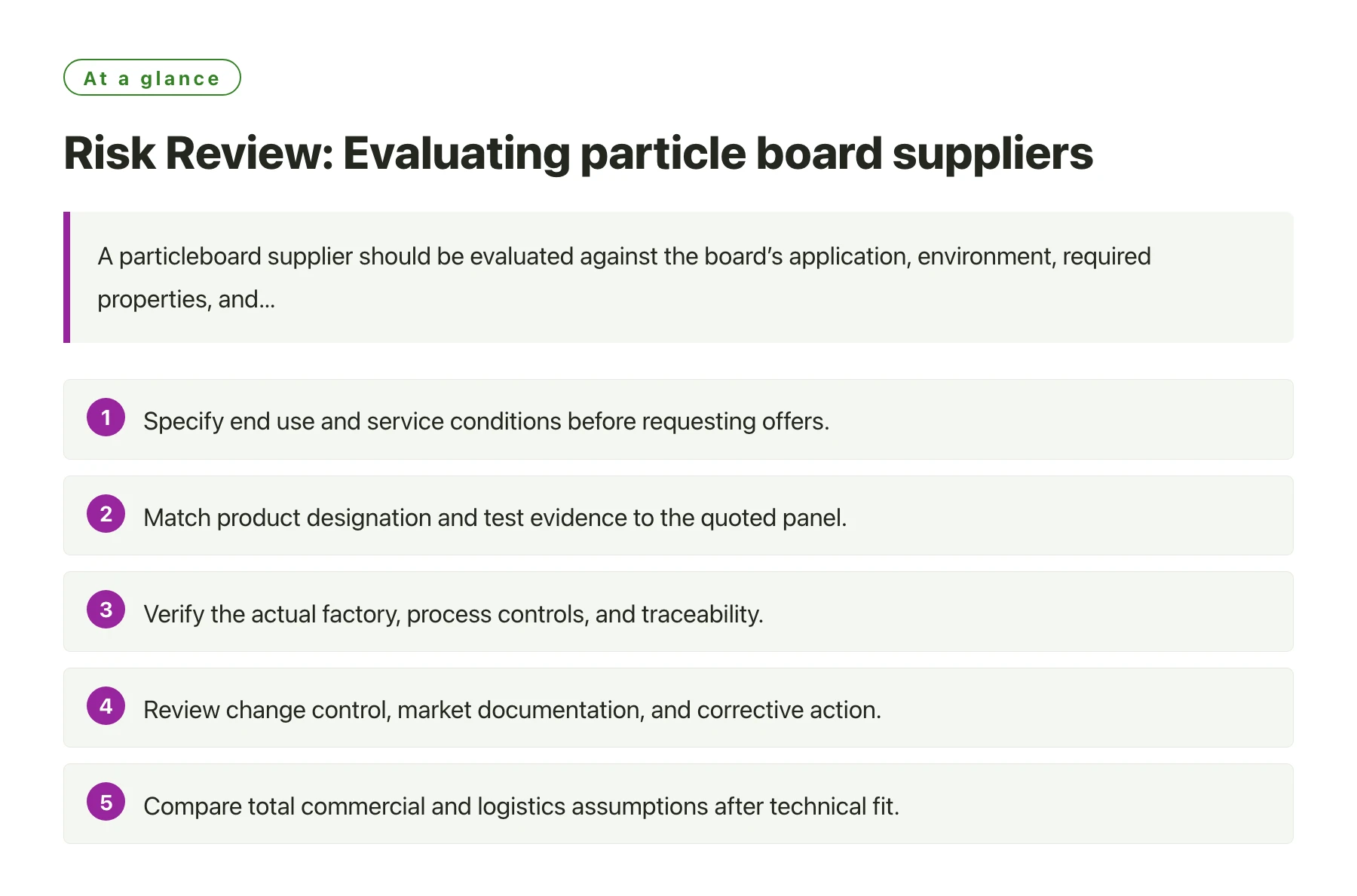
Key takeawaysSpecify end use and service conditions before requesting offers. · Match product designation and test evidence to the quoted panel. · Verify the actual factory, process controls, and traceability. · Review change control, market documentation, and corrective action. · Compare total commercial and logistics assumptions after technical fit.
Particleboard offers can appear similar while differing in grade, thickness, surface, process, and intended conditions. The review should connect every claim to the exact product and manufacturing source.
1. Define the panel’s actual end use
Particleboard is not a single interchangeable product. A panel for dry interior furniture may face different demands from a board used in humid rooms, a load-bearing application, or a surface that will be laminated and machined. Describe the end use, environment, expected service, thickness, dimensions, edge treatment, and downstream process before asking suppliers to quote.
Separate minimum performance from preferences such as color, surface texture, or preferred core composition. Identify who approves technical deviations and which requirements need test evidence. When a panel will be part of a structural or regulated assembly, have a qualified designer or compliance owner set the relevant performance requirements; a supplier comparison cannot replace that review.
2. Confirm grade, service condition, and declared properties
Ask the supplier to state the product designation, intended use, service condition, thickness range, and properties relevant to the order. ISO 16893:2016 covers classification and manufacturing property requirements for particleboard categories and service conditions; its published values are not design values. Buyers should obtain the applicable standard and have a qualified reviewer decide whether it fits the actual application. [1]
Request a product data sheet tied to a manufacturer, plant, product family, and current revision. Check that claims match the order’s thickness and surface treatment. A brochure for a similar panel or another factory is not evidence that the quoted material has the same classification or production controls.
3. Check legal identity and manufacturing capability
Verify the entity that will contract and invoice, the factory address, and the relationship between the seller and production site. Ask whether manufacturing, sanding, overlay, or packing is subcontracted. Record who controls raw material purchasing, process parameters, inspection, and corrective action at each location.
Review evidence of relevant production equipment and experience with comparable panel dimensions, thicknesses, finishes, and order volumes. A visit report or video call can help confirm operations, but note what was directly observed and what remains a supplier statement. Do not equate a trading company’s portfolio with the capability of the named factory.
4. Evaluate consistency and test evidence
Ask for recent test reports that identify product, plant, sample date, thickness, test method, laboratory, and measured results. Match each result to a purchase requirement and check whether it covers the offered grade. If a report omits identity or traceability, ask how the tested specimen connects to routine production.
Select tests with a qualified technical owner. Potential properties may include dimensions, moisture, density profile, internal bond, bending performance, surface quality, or moisture-related behavior, depending on use and applicable specification. Avoid treating an isolated passing sample as proof of every batch; define routine controls and acceptance criteria in the contract.
5. Review raw materials, process, and change control
Ask how incoming furnish, resin systems, additives, and recycled content are specified and checked where they matter to the intended use. Clarify how the manufacturer controls blending, mat formation, pressing, cooling, trimming, and sanding. The goal is to understand repeatability and traceability, not to demand confidential recipes that the supplier cannot reasonably disclose.
Specify notification and approval for changes to resin, furnish source, plant, process, grade, thickness tolerance, or surface treatment. Require the supplier to explain how a change affects performance and what validation will be provided. A stable approved baseline makes later inspection and claim review much easier.
6. Examine emissions, safety, and market documentation
Identify emissions or chemical requirements for the destination market and finished application. Ask for current reports or declarations that identify the tested panel and method; check whether an overlay, coating, or edge treatment changes the scope. Regulatory and building requirements vary by jurisdiction and product use, so have a qualified owner confirm the applicable rules.
Request labels, technical files, declarations, and traceability documents needed for the shipment and downstream assembly. A general certificate should not be assumed to cover every product family, thickness, or facility. Note expiry dates and scope, and ask the issuing organization or laboratory to confirm authenticity when the decision warrants it.
7. Assess quality management and corrective action
Review incoming inspection, in-process controls, final release, nonconforming product segregation, calibration where applicable, and complaint handling. Ask for an example of a corrective-action record with confidential information removed. A useful record shows the issue, containment, cause analysis, corrective action, verification, and prevention of recurrence.
Check whether records link lots to production dates, inputs, test results, and shipment cartons. If a defect appears after delivery, traceability supports a focused investigation instead of a general dispute about which order or batch was involved. Define how long records are retained and how quickly the supplier will provide them.
8. Compare commercial and logistics risks
Compare panel price only after aligning grade, dimensions, tolerances, surface, packing, quantity, and evidence requirements. Include yield loss, protective packaging, pallets, container loading, inland haulage, shipment timing, and claims handling where relevant. Clarify how the quote treats rejected or damaged panels and who pays for reinspection or replacement.
Ask about lead times for the specified grade, minimum runs, production capacity during peak periods, and contingency plans for raw material or equipment disruption. Separate normal lead time from a supplier’s best-case estimate. A cheaper offer may be a reasonable choice if assumptions and fallback options are explicit.
9. Use samples and pilot orders carefully
Select samples that represent the offered grade and manufacturing route. Record dimensions, surface treatment, lot identity, and whether the sample is production-run material or a special hand-picked piece. Define what the sample can demonstrate and what it cannot, such as long-term behavior or full-lot consistency.
For a pilot, agree quantity, inspection method, acceptance limits, packaging, and what evidence is needed before scaling. Compare the pilot result with the approved specification and then record any changes to the production order. Do not allow sample approval to silently waive a critical performance requirement.
10. Make a documented supplier decision
Score suppliers on end-use fit, evidence quality, process control, traceability, change management, communication, commercial terms, and recovery capability. Keep mandatory requirements separate from scored preferences. Record unresolved points, the decision owner, and the evidence needed to close each one before award.
A buyer reviewing Shanghai JS Sourcing can use the same matrix to coordinate factory checks, compare particleboard offers, and document open questions. Confirm that the selected factory, quoted product, test evidence, and shipping plan all refer to the same approved configuration before placing the order.
Sources
Frequently asked questions
What should I ask a particleboard supplier first?
Ask for the intended-use grade, service condition, plant identity, product data, relevant test reports, traceability, and change-control process.
Does a standard designation prove the board suits my project?
No. Confirm the application, applicable market rules, product properties, and design requirements with a qualified reviewer.
Are samples enough to approve a full production order?
Samples help assess identified characteristics, but the buyer should also define routine lot controls, acceptance criteria, and traceability.
How can I compare offers from different factories?
Normalize grade, dimensions, tolerances, surface, test evidence, packaging, delivery assumptions, and corrective-action terms before comparing total cost.