How to Read a Mining Pool Dashboard in Under Two Minutes
A pool dashboard answers one question well: is the hashrate I am paying for actually being credited to me? Read four numbers in a fixed order — your reported hashrate, your effective hashrate, the pool's share of network hashrate, and the payout method — and the rest of the page is context. At today's difficulty a 100 TH/s machine produces about 0.0000449 BTC a day, roughly $3.80, so a 5% gap between reported and effective hashrate is around $0.19 a day of income that quietly disappears.

Key takeaways
- Reported hashrate is what your machines claim; effective hashrate is what the pool credited. The second number is the one that pays — at 100 TH/s a 4% gap is about $0.15 a day per rig, or roughly $4.50 a month.
- Payout method is a fee decision: a listed 4% applies to the PPS-settled block-reward component and a listed 2% to the transaction-fee component under PPS+, while PPLNS combines both at a listed 2%.[1]
- Cadence matters more than headline: PPS+ settles hourly against current difficulty, so a dashboard read twice a day is enough to catch a fault before it costs a full day of income.
- Scale sets the arithmetic — 1 PH/s grosses roughly 0.000449 BTC a day ($37.99), while 10 PH/s on 20 J/TH machines draws about 200 kW, or 4,800 kWh a day.
The short answer
Open the page and look at three things in order. First, the pool's share of network hashrate — it tells you how steady your payouts will be, because a pool that holds a larger slice of the network finds blocks more regularly. Second, your own effective hashrate against your reported hashrate. Third, the payout mode and its settlement cadence.
If the first two are drifting, the third will not save you. If your effective hashrate tracks your reported hashrate within a percent or two, and the pool's share of network hashrate is stable from week to week, your income is behaving exactly as the formula predicts — your share of the network times 450 BTC a day, times one minus the listed fee. There is nothing else to check.
How the mechanism works
A pool does not mine for you. It hands your machines easier targets than the network's, collects the shares that meet them, and pays you in proportion to what those shares prove. That accounting runs on valid shares, which is why the pool's own ViaBTC BTC Mining Pool statistics page leads with pool hashrate, network hashrate, difficulty and miner count: four numbers that together define how big a slice of the network the pool controls and how smoothly payouts will land.
Effective hashrate is a translation of shares into the language of hardware. When a machine submits shares at the expected rate, effective equals reported. When shares arrive late, stale, or rejected, effective falls below reported even though the fans are still spinning and the power meter still reads the same. That is the single most expensive failure mode in mining: you pay for electricity on reported hashrate and you get paid on effective hashrate.
| Metric | What it tells you | Warning sign | First move |
|---|---|---|---|
| Pool share of network hashrate | How often the pool finds blocks, and therefore how regular your payouts are | Share shrinking across several weeks | Check whether the pool supports the coins and payment modes you need before re-pointing hashrate |
| Network hashrate and difficulty | The denominator of every income calculation you will ever run | Difficulty rising faster than your hashrate | Recompute daily income at the new difficulty before buying hardware |
| Reported hashrate | What your miners say they are producing | Machine at zero while your monitoring says it is online | Restart the miner; check the pool URL and worker name |
| Effective hashrate | What the pool credited you for | Persistent gap of more than a few percent below reported | Measure latency to the pool's nodes and inspect rejected shares |
| Stale and rejected shares | Wasted hashing, and the most common cause of that gap | A rising stale rate with a stable reported hashrate | Move to a nearer node or a more stable connection |
| Payout mode and cadence | When money lands and which fee applies to which component | Cadence that does not match your electricity cycle | Compare PPS+ and PPLNS against your tolerance for variance |
Where miners get it wrong
The first mistake is reading the pool's hashrate as a proxy for profitability. Pool size changes how quickly income smooths out, not how much of the network you control. Two pools with exactly the same fee structure and settlement rules pay the same expected amount for the same machine; one just delivers it in more, smaller pieces.
The second mistake is treating every mode as if it were a monthly salary. Under PPS+ the block-reward component is settled per share at a listed 4% rate and the transaction-fee component follows PPLNS logic at a listed 2%, paid hourly against current difficulty. Under PPLNS the two components are combined in one distribution at a listed 2%, and the distribution follows the blocks the pool actually finds, after six confirmations, weighted by each miner's share of pool hashrate over the last five difficulty rounds.[2] A quiet week under PPLNS is not necessarily a broken rig; a quiet week under PPS+ usually is.
The third mistake is chasing hashrate without asking what a machine costs to run. A 100 TH/s unit at 20 J/TH draws about 2 kW, which is 48 kWh a day — roughly $2.88 at $0.06/kWh against $3.80 of gross income at current difficulty. Once the listed 4% fee is applied to the block-reward component, the residual is thin enough that a few percent of stale shares decides the outcome. Before buying or keeping a machine, check where it sits on a miner profitability ranking measured against today's price and difficulty.
Worked example
Suppose you run 100 TH/s. At a network hashrate of about 1,003 EH/s and a subsidy of 3.125 BTC per block across 144 blocks a day, your share of the network produces about 0.0000449 BTC a day — $3.80 at a $84,692 BTC price. Payment mode barely changes that: after the listed 4% fee on the block-reward component, the daily figure is roughly $3.65.
Now let a connection problem cost you 4% of effective hashrate for a month. Gross falls to about 0.0000431 BTC a day, $3.65 before fees and roughly $3.50 after, so the loss is in the region of $0.15 a day per machine — $4.50 a month, or $54 a year for a single rig. Nothing on the dashboard flags it: reported hashrate stays flat, fans stay loud, and only the effective line drifts. Multiply it by a hundred machines and a careless month costs thousands, which is the entire argument for a two-minute read done on a schedule.
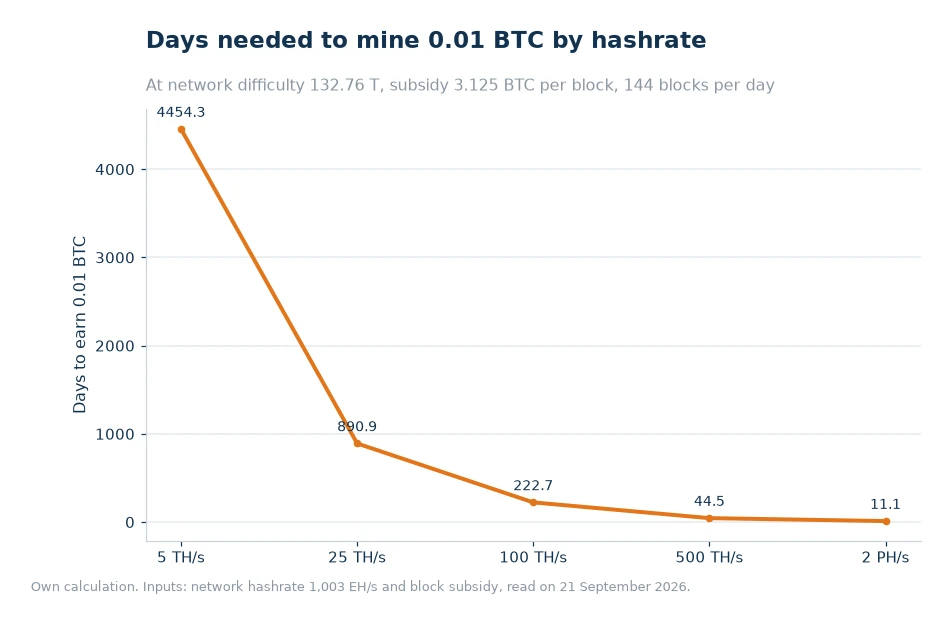
The curve also explains why patience is not a strategy at small scale: 5 TH/s needs about 4,454 days at current difficulty to produce 0.01 BTC, against 44.5 days at 500 TH/s. Sanity-check a machine with an income calculator, and feed it your effective hashrate rather than your reported one.
A checklist you can run today
- Write down four numbers. Reported hashrate, effective hashrate, pool share of network hashrate, payout mode. Date the note.
- Compare effective against reported. Under 1% difference is healthy; anything above a few percent is a fault to chase the same day.
- Check the difficulty change. The next adjustment was estimated at about -2.12% when these figures were read. Recompute income rather than assuming it is flat.
- Confirm the cadence fits the bills. Hourly settlement is useful when electricity is paid monthly in arrears, less useful if you simply reinvest.
- Match the mode to your tolerance. Steadier income with a higher listed fee on the block-reward component, or a lower listed fee with reward variance on your side of the table.
- Set an alert, then stop looking. Notifications for effective hashrate, not price. The dashboard is a two-minute habit, not a full-time feed.
Frequently asked questions
Do mining pools cost anything to join?
Joining is free; the pool earns from its fee on settled payouts, which appears as a percentage of the block-reward and transaction-fee components.
Can I mine more than one coin at the same time?
Yes. Merged mining lets a machine secure a parent chain and an auxiliary chain together, and multi-coin pools support switching between chains without moving hardware.
What is the difference between reported and effective hashrate?
Reported hashrate is what your hardware claims to produce; effective hashrate is the hashrate the pool derives from the valid shares you actually submitted. The gap between them is stale or rejected work, and income follows the effective number.
The two-minute habit
Pick a time, open the page, and read the same four numbers in the same order: effective against reported hashrate, the pool's share of the network, difficulty, and your payout mode. If nothing moved, close the tab; if something did, you have found it a month before the bank statement would have.
Data and sources: ViaBTC pricing[1], the ViaBTC fee breakdown[2] and public chain difficulty data. Network difficulty (132.76 T), network hashrate (about 1,003 EH/s), the 3.125 BTC block subsidy, BTC at 84,692 and the estimated -2.12% difficulty change were all read on 21 September 2026, and every calculation in this piece derives from those inputs; figures move with difficulty and price.