How Brewery Prices Are Built: A Published Example
A price range is only useful when you know what sits inside it. HGMC publishes a complete 10 BBL installation at around US$75,000-200,000 and then lists the bill of materials item by item, which turns a wide range into a scope you can actually check against your own site.

Key takeaways
- The published example for a complete 10 BBL system is around US$75,000-200,000, and the same page names valves, pipes and a steam boiler as the items that move the figure.
- The published bill of materials covers the brewhouse, a 20 BBL hot water tank, pumps, piping, a 10 m2 heat exchanger, a platform, four fermentation tanks, glycol, a chiller, a CIP unit and a control cabinet.
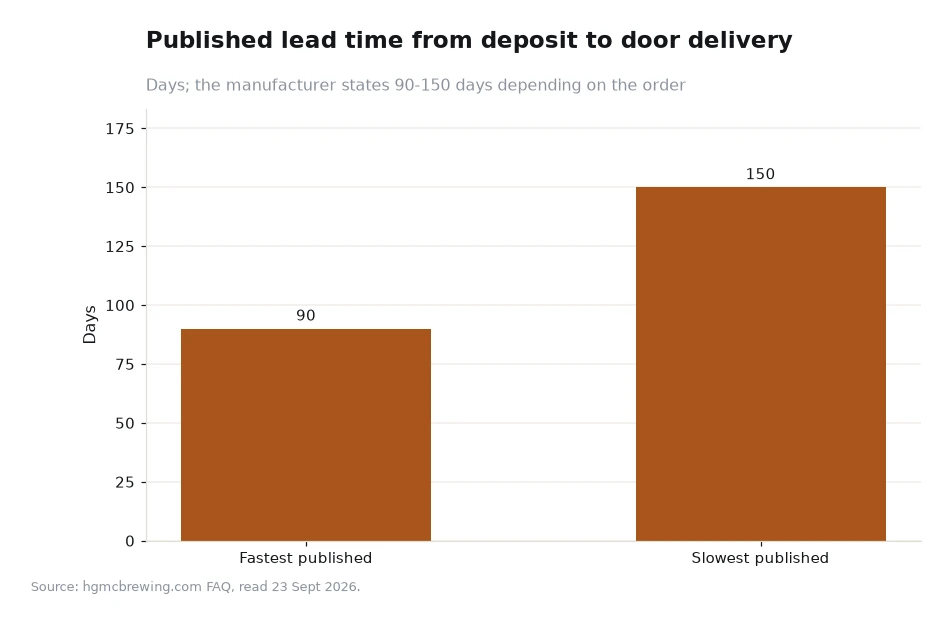
- Delivery is published at 90-150 days from deposit to door delivery, so the price conversation and the opening date are the same conversation.
- Free 2D, 2.5D and 3D design for layout and piping is part of the published service, which is where a quote gets tested against a room.
The Published Example, Item by Item
The published list for a 10 BBL brewery system is long, and it is worth reading in the order the beer travels rather than alphabetically. Wort side: the mash/lauter tun and a steam-heated kettle/whirlpool tun of 10 BBL each. Water and heat side: a 20 BBL hot water tank twice the brew length, a 3 m3 wort pump with its hot water pair, stainless steel 304 wort pipes and a 10 m2 plate heat exchanger. Then the working parts of a room: an operation platform and four 10 BBL fermentation tanks, followed by the glycol tank, the chiller, the cooling pipes and valves, a CIP unit and a semi-automatic control cabinet.
Read it as three groups rather than thirteen lines. The vessel group is the brewhouse and the hot water tank. The process group is the pump, the piping, the heat exchanger and the CIP unit. The cold and control group is the four fermentation tanks, the glycol tank, the chiller and the cabinet. Once a quote is divided that way, an item that has been quietly left out is easy to spot, and so is an item that has been doubled.
What Moves the Number
The published page is explicit about the reason for the wide range: valves, pipes, steam boiler and other requirements change the figure. Of those, the boiler is usually the largest single addition, because choosing steam heating at the kettle commits the project to a boiler, fuel supply, a flue, water treatment and the plant room space to hold it. The same brew length with a different heat source carries a different total, without any change to the vessels.
The second mover is pipework and valves. A brewery built into an existing wet room with the tanks in a row needs short runs and few isolation points; a brewery spread across two floors with a remote cold room needs more pipe, more valves, more glycol line and a bigger pump to push the flow through it. Both are the same brewhouse. Only one of them fits the bottom of the published range.
Control Level and Design Work
Control is the third variable. Three grades are published: a PID display panel, a PLC touch screen running semi-automatically, and a fully automatic PLC panel with curve indication and production-record printing. The 10 BBL example above specifies the middle grade, so a buyer comparing quotes at the top and the bottom of the range should check which panel is included before assuming the difference sits in the steel.
Design work, by contrast, is published as free: 2D, 2.5D and 3D design covering the brewery space layout and the brewhouse vessel and piping design. That is worth using early, because a 3D layout is the most direct way to discover that the boiler does not fit where the plan assumed it would, and because the design is created before the vessels are built rather than after delivery.
The Delivery Window Is Part of the Cost
Time costs money at both ends of a project. The published delivery window is 90-150 days from deposit to door delivery, depending on the order, which is long enough that a deposit wired two weeks late can push commissioning past a planned opening and short enough that there is no room for a specification change halfway through. Fix the scope first, then start the clock.
It is also worth asking what happens across the window. Installation, commissioning, operator training, maintenance support and spare parts supply are all published as part of the service, along with a 6-year warranty on tank accessories and electronic components against manufacturing defects from the factory when used within scope. Those items do not appear in a price per litre figure, but they decide what the second year of ownership costs.
| Package item | Published specification | Why it moves the price |
|---|---|---|
| Mash/lauter tun | 10 BBL | The vessel that sets the brew length, so every downstream size follows it |
| Kettle/whirlpool tun | 10 BBL, steam heated | Steam heating is the choice that pulls in a boiler, fuel and a plant room |
| Hot water tank | 20 BBL | Twice the brew length, sized to cover sparging and cleaning draws |
| Fermentation tanks | Four at 10 BBL | The count that decides weekly output, and the largest single line in most quotes |
| Heat exchanger and pipes | 10 m2 plate exchanger, stainless steel 304 wort pipes | Pipe runs and valve counts grow with the distance between your tanks, not with the brew length |
| Control cabinet | Semi-automatic control system | The step from panel control to full automation is a separate, significant line item |
Worked example
The figures below are a worked example based on the published range, not a quotation. Assumptions: 1 BBL = 117 L, so 10 BBL = 1,174 L of brew length; one brew day a week becomes two; and fifty brewing weeks a year for the per-brew arithmetic.
Start with capacity cost. The low end is US$75,000 / 1,174 L = US$63.9 per litre of brew length; the high end is US$200,000 / 1,174 L = US$170.4 per litre. Per barrel, the same range is 75,000 / 10 = US$7,500 to 200,000 / 10 = US$20,000. Those two figures are the honest way to compare this system against a 5 BBL kit or a 20 BBL plant, because comparing totals alone ignores the size of the vessels you are buying.
Then divide by the brew. At two brews a week and fifty weeks, a 10 BBL system runs 100 brews a year, so the low end works out at 75,000 / 100 = US$750 per brew and the high end at 200,000 / 100 = US$2,000 per brew. At 1,174 L a brew, that is US$0.64 to US$1.70 per litre of capacity produced in year one, before ingredients and labour. Spread over the working life of the vessels the number falls further, which is why the equipment range rather than the equipment total is what belongs in a business plan.
Finally, test the scope against the spread. The published range is US$125,000 wide (200,000 - 75,000) across 13 named package items, which averages 125,000 / 13 = US$9,615 per line item if the difference were spread evenly. It is not spread evenly, of course: a steam boiler, a longer pipe run and a fully automatic panel absorb most of it. That is the list to interrogate, and it is a much shorter conversation than arguing about the total.
Frequently asked questions
What is included in the published price for a 10 BBL system?
The published example is around US$75,000-200,000 for a complete 10 BBL system, and the bill of materials names the mash/lauter tun, kettle/whirlpool tun, hot water tank, pumps, wort pipes, plate heat exchanger, platform, four fermentation tanks, glycol tank, chiller, cooling pipes and valves, CIP unit and control cabinet. Valves, pipes, a steam boiler and other requirements change the figure.
Why does the published range span three times the money?
Because scope varies, not because the vessels vary. Steam heating adds a boiler, fuel supply and a plant room; a longer distance between tanks adds pipe, valves and pump duty; and the step from a semi-automatic control cabinet to a fully automatic panel with curve indication and record printing is a line item of its own in a much wider package.
Price the Scope, Then Start the Clock
Take the published bill of materials, mark every item as required, optional or already on site, and only then compare totals. A quote that comes in at the bottom of a range with the boiler, the longer pipe run and the automation left out is not cheaper; it is smaller.
The micro craft system pages show how the same logic works one step down, the large commercial pages show it two steps up, and the main site carries the published sizes, the free 3D design service and the 6-year warranty on tank accessories and electronic components against manufacturing defects.
Then agree the delivery plan in the same document, because the published window runs 90-150 days from deposit to door delivery and it starts the day the deposit is paid. A scope that is settled before that payment is a scope that arrives on schedule; one that keeps changing is an opening date that keeps moving.
Published figures here come from the manufacturer's own website (hgmcbrewing.com), read 23 Sept 2026: the 10 BBL bill of materials and the US$75,000-200,000 example range, the control levels, the 90-150 day delivery window, the free 2D/2.5D/3D design service and the 6-year warranty on tank accessories and electronic components against manufacturing defects. Per-litre, per-barrel and per-brew figures are the author's own arithmetic.[1]