Five Formula-Ownership Mistakes Brands Make Before a Launch
Most formula-ownership disputes are not caused by a supplier behaving badly; they are caused by a buyer leaving a decision unmade and assuming the friendly answer. The five mistakes below account for the large majority of the cases worth worrying about, and each one is cheap to close at the start of a project and expensive to close afterwards. If you only fix one thing before a launch, fix the exclusivity scope.
Key takeaways
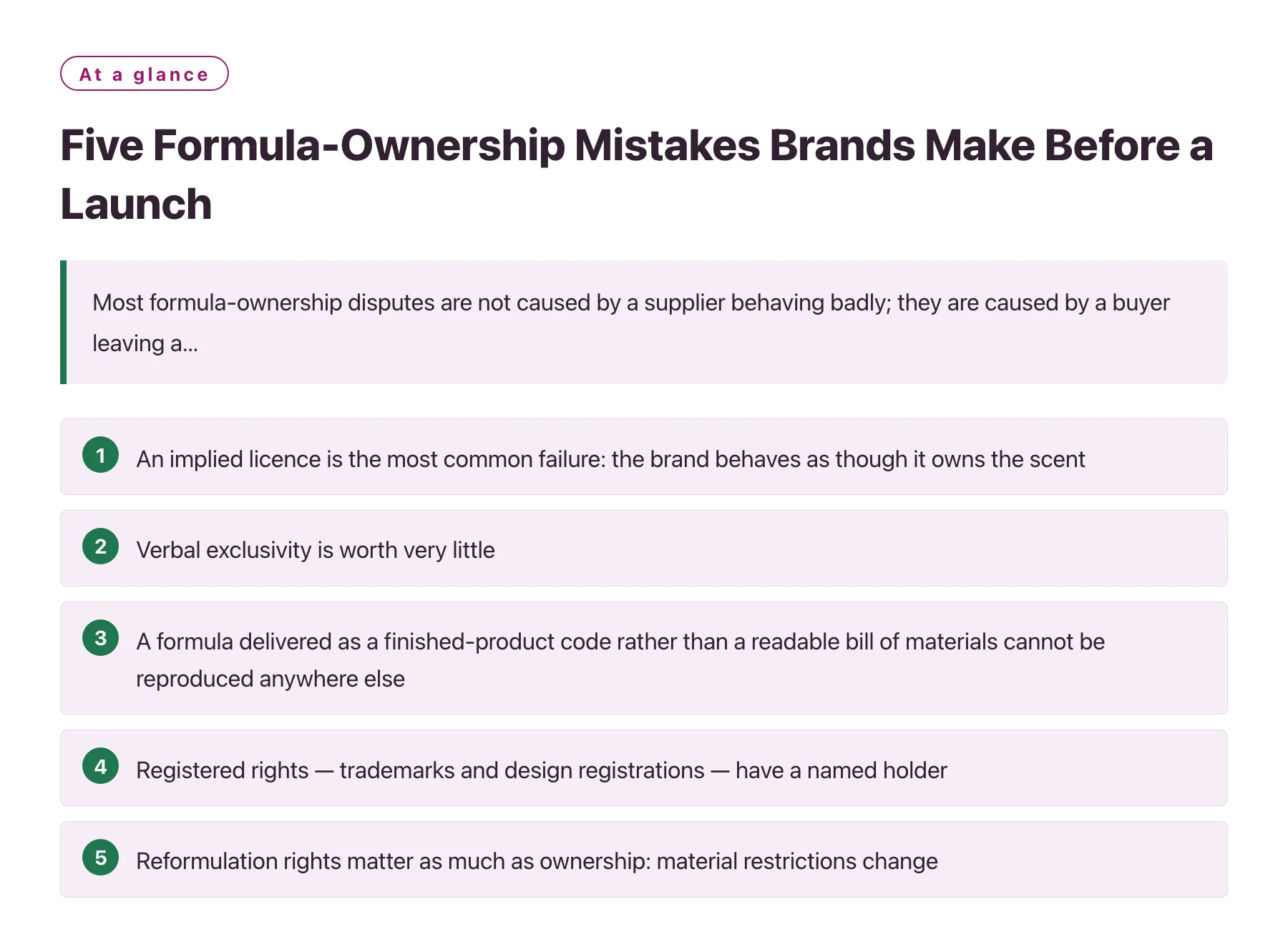
- An implied licence is the most common failure: the brand behaves as though it owns the scent, the contract says nothing, and the manufacturer's default position is that it owns the base.
- Verbal exclusivity is worth very little, because the person who promised it is rarely the person who can confirm it two years later.
- A formula delivered as a finished-product code rather than a readable bill of materials cannot be reproduced anywhere else, which defeats the purpose of owning it.
- Registered rights — trademarks and design registrations — have a named holder, and if the supplier files them the brand is negotiating from behind [1].
- Reformulation rights matter as much as ownership: material restrictions change, and a formula you cannot adjust is a formula you cannot keep selling [2].
Ownership failures rarely announce themselves. They surface eighteen months later, when a brand tries to move a successful product to a second manufacturer, or when a retailer asks for documentation that only the factory holds, or when a competitor launches something that smells suspiciously familiar.
The pattern behind all five mistakes is the same: a question that felt awkward to ask early became a question nobody could ask later. None of the fixes require a confrontational conversation. They require a sentence in a document.
Mistake one: treating an implied licence as ownership
A brand briefs a factory, the factory develops an accord from its own library, the brand approves it, and everyone behaves as though the scent belongs to the brand. Nothing in writing says so. When the brand later wants a second production site for a regional launch, it discovers that the base was never transferred, because it was never the brand's to transfer.
The fix is a single line in the development agreement that states which of three positions applies: the brand owns the formula, the manufacturer owns it and licenses it exclusively, or the manufacturer owns it and licences it non-exclusively. Any of the three can be negotiated. Silence cannot.
Why the default is usually the manufacturer's
Development houses build libraries, and libraries exist to be reused. A base created for client A is often an adaptation of something created for client B, which makes clean ownership harder to claim than it looks. This is not a trick; it is how the economics of a development house work. It is also why the conversation has to happen before development, not after.
The other four, and the fix for each
- Accepting exclusivity verballyAsk for it in the development agreement with a named accord, named categories, named territories and a duration. If it is not written, plan on the assumption that it does not exist.
- Taking delivery of a product code instead of a formulaRequest a bill of materials with material names and percentages, plus the filling specification. A code is a label for someone else's file, not a document you own.
- Letting the supplier register the brand assetsTrademarks and design registrations should be filed by the brand, or assigned to it in writing on the same day they are filed. A registration held by a supplier is leverage you have handed away.
- Freezing the formula with no reformulation rightWrite in the right to adjust the formula for regulatory or supply reasons, with a defined approval process. Restrictions on fragrance materials are revised periodically, and a frozen formula ages badly.
What each mistake costs when it surfaces
| Mistake | First symptom | Real cost |
|---|---|---|
| Implied licence | A second manufacturer cannot match the scent | A full redevelopment, plus the launch delay that comes with it |
| Verbal exclusivity | A similar product appears from another brand | Positioning damage that cannot be recovered by a discount |
| Code instead of formula | No one can explain what changed between batches | Slow problem-solving every time a batch drifts |
| Supplier-held registrations | A renewal notice arrives addressed to the factory | A negotiation conducted with very little leverage |
| No reformulation right | A material restriction lands mid-season | Unsold stock and an emergency reformulation |
| No tooling clause | Leaving means leaving the bottle behind | New tooling cost and a second qualification cycle |
Notice how little of this is about price. Ownership mistakes are rarely the most expensive line in a project budget; they are the ones that make the other lines unrecoverable.
A useful exercise before signing: write the sentence you would want to be able to quote if the relationship ended badly in two years. If that sentence is not in the document you are about to sign, add it now, while both sides are still optimistic.
How to raise it without souring the project
Founders frequently avoid the ownership conversation because it feels like an accusation. Framing it as a project requirement rather than a doubt changes the tone completely. Manufacturers are asked about ownership constantly; a supplier that handles the question smoothly is usually one with a standard answer and a standard document.
It also helps to arrive with the paperwork half-written. A one-page term sheet covering the formula file, the exclusivity scope, the tooling and the artwork is easier to agree than an open-ended discussion, and it lets the manufacturer respond to something specific. The same list is worth running against any new supplier, whether the candidate is the company behind the factory at a large manufacturer or a small development studio.
Make it a habit rather than a one-off conversation
Two habits make the difference over time. First, keep your own copy of everything — the bill of materials, the approved sample record, the artwork source files. Second, review the ownership page whenever the product changes, because a reformulation or a new market is exactly when an old clause stops covering the new situation. It is also the point at which examples of fragrance projects from other brands become genuinely instructive, since the same questions recur across categories.
The same review is worth repeating whenever a product changes market, pack or concentration, because that is when an old clause stops covering the new situation.
What a supplier's own disclosure is worth
None of this is a reason to distrust a manufacturer. It is a reason to make the arrangement explicit, so that a productive relationship does not depend on everyone remembering the same conversation the same way. The brands that get this right are usually the ones that raise it in the first meeting, before there is anything to argue about — and a supplier such as Xuelei fragrance brand, which publishes its service scope publicly, makes that first meeting easier because there is already something concrete on the table.
Disclosure is not a substitute for a contract, but it shortens the conversation that produces one. A company that already publishes its service scope has effectively pre-answered part of the checklist.
Sources
- WIPO — World Intellectual Property Organization —— The UN agency for intellectual property; resources on industrial design and patent protection relevant to product and packaging design.
- IFRA Standards Library (International Fragrance Association) —— The IFRA Standards Library lists the restrictions the fragrance industry applies to individual fragrance ingredients, based on safety assessments; it is the reference point for compliant fragrance formulation.
Frequently asked questions
What is an implied licence in fragrance development?
It is the situation where a brand has paid for development, uses the scent commercially, and behaves as though it owns the formula, while the contract is silent on the point. Legally the manufacturer may still hold the base, which means the brand cannot reproduce the product elsewhere without permission.
Can I get exclusivity after the project has already started?
Usually yes, but the price changes. Exclusivity is cheapest before development begins, when the manufacturer has not yet invested in the base and can price the restriction into the development fee. After a product is selling, the manufacturer has more to lose and less reason to be generous.
Should the brand or the manufacturer register the bottle design?
The brand, or the manufacturer as a filing agent with an immediate written assignment to the brand. The registration should name the party that intends to keep selling the product, so that renewals, oppositions and enforcement all sit in the right hands.
How do I know whether a formula file is complete enough?
Give it to a different perfumer and ask whether they could reproduce the scent from it. If the answer is no, the file is a reference document rather than a formula, and the gap should be resolved before the next order.
Does owning the formula mean I can change it whenever I want?
Not necessarily. Ownership and reformulation are separate rights. Ownership lets you hold and use the document; the right to modify it usually needs its own clause, along with a process for re-approving the sample and re-testing stability after a change.