Formwork Panels Explained: Core, Glue and Film Weight
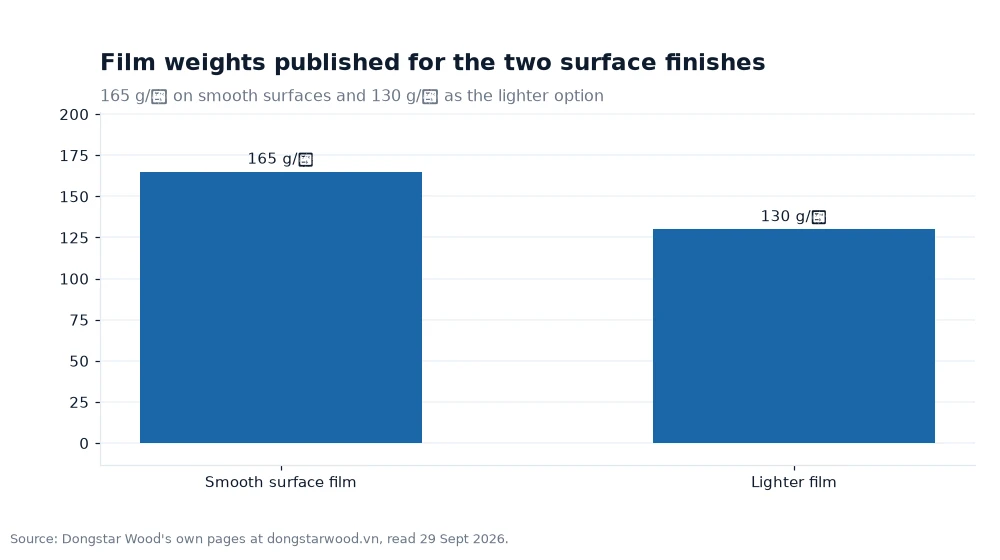
Three variables decide what a formwork panel does on site: the core species, the adhesive class and the weight of the film. Published film weights are 165 g/㎡ where the surface is smooth and 130 g/㎡ for the lighter option, while the core list runs to six combinations — variation that changes reuse counts without changing the sheet size on the drawing.

Key takeaways
- Cores offered: Birch, Eucalyptus, Acacia, White Hardwood, Rubber and Combi — six options on one page.
- Adhesives span E0, E1, E2, MR, WBP and Phenolic Dynea, so glue class is a specification choice rather than a default.
- Smooth-surface film is quoted at 165 g/㎡; the lighter film at 130 g/㎡.
- High-grade panels are published at 10–20 reuse cycles, with 18 mm as the all-round thickness and 21 mm+ for bridges and high-load platforms.
Core species and the job each one suits
Core selection is a load question before it is a price question. Eucalyptus gives maximum strength and high compression resistance, with the bending performance you want on walls carrying wet concrete at speed. Acacia, a dense hardwood, brings superior load-bearing capacity and a long service life where a panel is used again and again in the same jig.
White Hardwood — species such as Bodhi or mixed light hardwoods — trades a little peak strength for stability and balanced mechanical properties at a workable cost. Combi cores, either Eucalyptus and Acacia or hardwood and softwood, exist to balance strength, weight and cost when a site is lifting panels by hand.
Film weight and the finish it leaves behind
The surface film does two jobs: it releases cleanly from cured concrete and it protects the face veneers underneath. A 165 g/㎡ film on a smooth surface is the specification for a fair-faced finish where the concrete is left visible, and the 130 g/㎡ film is the lighter, more economical route for work that will be rendered or clad.
A Film Faced Plywood order is usually written in the opposite sequence: sheet size first, then core, then glue, with the film added at the end. It is worth reversing that habit, because the film is the line the site team notices first and the one that decides whether the concrete comes out fair-faced.
Films named on the product pages are Dark Brown Film, Black Film and Anti Slip Film, and the choice is partly aesthetic: dark and black films are conventional on European sites, while a texture is added when people will be walking or kneeling on the formwork itself rather than only pouring against it.
| Component | Options published | What it changes on site |
|---|---|---|
| Core | Birch, Eucalyptus, Acacia, White Hardwood, Rubber, Combi | Load capacity, panel weight, service life |
| Adhesive | E0, E1, E2, MR, WBP, Phenolic Dynea | Water resistance and emission class |
| Surface film | 165 g/㎡ smooth, 130 g/㎡ lighter | Release quality and concrete finish |
| Thickness | 18 mm, or 21 mm and above | Deflection under wet concrete loads |
Reading a European formwork drawing
The same board often appears on drawings as formwork plywood rather than by product family, and the specification that follows usually calls for a phenolic film surface because it releases cleanly from cured concrete and keeps the veneers behind it protected. When a drawing says film faced, three questions follow: which film weight, which core, and which glue class.
Two further lines belong in that specification. Edges are sealed to keep water out of the core between pours, and the textured surface is substituted where formwork doubles as an access route. Settling both before the order is placed avoids a substitution conversation after the panels have already been cut to size.
Adhesive classes from MR to Phenolic Dynea
Glue decides how the panel behaves once it gets wet, and the published range covers E0, E1, E2, MR, WBP and Phenolic Dynea. MR is the dry-interior grade; WBP is the boiling-water-resistant class that most exterior concrete work is built around; Phenolic Dynea names the phenolic system used where the highest water resistance is specified.
E0, E1 and E2 describe emission performance of the panel rather than its weather resistance, which is why a quotation should state both. A panel can carry an E1 emission class and a WBP glue line at the same time, and the two numbers answer different questions from a specifier.
Formats, thickness and the reuse budget
The size list opens at 1220 × 2440 mm and runs through 1250 × 2500 mm and 1500 × 3000 mm, with bespoke sheets reaching a ceiling of 1830 × 3830 mm. Thickness guidance is straightforward: 18 mm covers most heavy formwork, while 21 mm and thicker is reserved for bridges and platforms carrying high loads.
Shipments rarely contain one format. A programme that mixes 1250 × 2500 mm wall panels with 1830 × 3830 mm custom sheets is normal, and it is worth asking how the mill separates the pallets so that the right board reaches the right pour without a sorting exercise in the yard.
Against that sits the reuse figure. High-grade panels are published at up to 10–20 times in concrete pouring projects. That number is not a property of the film alone — it follows from core density, glue class and how carefully edges are treated between pours, which is why the same sheet can last a season on one site and a fortnight on another.
Specifying before the first pour
Order a sample panel from a running batch rather than from the sample rack. Ask for the batch reference, the glue class and the film weight to be written on the board, then keep that panel until the first container arrives. Comparing a production panel with a quotation sample six months later is how specification drift gets caught early.
Write four lines into the enquiry: sheet size in millimetres, thickness, core species and glue class, plus the film weight and colour. Four lines are enough to turn a generic price into a comparable one, and they give the mill something to press against rather than a range to interpret.
Worked example: what one panel delivers in contact area
Start with the sheet. A 1250 × 2500 mm board is 1.25 × 2.5 m gives 3.125 m² of formwork face per pour. Over the published low end of the reuse range, one sheet gives 10 × 3.125 m² = 31.25 m² of total concrete contact area (example).
Scale it to a deck. A slab needing 500 m² of soffit formwork, poured once, takes 500 ÷ 3.125 = 160 sheets (example). Reuse the same panels across five pours and the requirement drops to 500 ÷ (3.125 × 5) = 32 sheets per cycle (example) — the arithmetic that makes a heavier, better-sealed board cheaper than a lighter one on long programmes.
Frequently asked questions
Which core should carry a high-load deck?
Eucalyptus, for compression resistance and bending performance, or Acacia where hardness and long service life matter more. Combi builds are the pragmatic middle ground when panels are handled manually and weight is a constraint on site.
Does a heavier film change the concrete finish?
It changes the surface it leaves. The 165 g/㎡ film on a smooth surface is specified for fair-faced work where the concrete stays visible, while the 130 g/㎡ film suits pours that will be covered by render, cladding or a screed.
What decides whether a panel reaches 20 pours?
Handling as much as construction: sealed edges, clean release between pours, flat stacking and a release agent applied evenly. A panel pulled apart with a crowbar at the edge loses cycles that the core and film were capable of delivering.
Comparing the two sides of the catalogue
Most buyers end up specifying across product families. The furniture and cabinet boards share the glue vocabulary with formwork panels but sit in different thickness bands, and the textured grip-surface option is the variant to look at when formwork doubles as a walkway or access platform.
Panel and film values are from the supplier's own site, checked on 29 Sept 2026 as referenced in this guide as referenced in this guide for the values in this comparison[1].